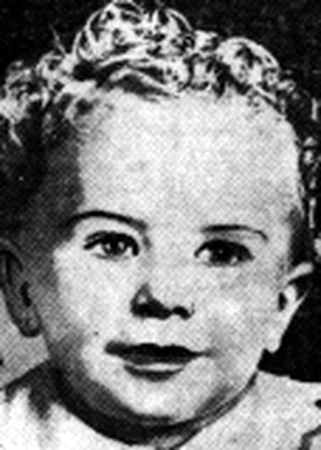
The Beilhartz family lived on Quebec Street in Denver, Colorado. William and his wife, Snowdrop, were the parents of ten children, the youngest of whom was four-year-old Alfred. Like many families looking to escape the summer heat, the Beilhartzes decided to spend the Fourth of July weekend of 1938 camping in the Rocky Mountain National Park.
They arrived at the park on July 2nd and set up camp roughly a quarter mile west of the Fall River Lodge. They weren’t alone—some family friends had joined them for the trip. Their campsite sat near the confluence of the Roaring and Fall Rivers, just below the natural landmark of Horseshoe Falls. It was a scenic location, surrounded by dense forest and the constant rush of mountain streams.
On the morning of July 3rd, the group woke up early. William went to a nearby stream to wash up, and Alfred came with him. Two of their friends, Oran Bronson and Walter Hansen, were also heading to the stream, about 500 feet upstream from where William and Alfred were. After finishing, William headed back to camp. Alfred told his father that he wanted to follow Oran and Walter instead and would return with them. William agreed and left him behind.
However, when Oran and Walter returned to camp shortly after, Alfred wasn’t with them. At first, it was assumed he may have wandered off and would turn up nearby. But when a search of the immediate area turned up nothing, concern grew quickly.
A search was launched almost immediately. Park rangers and volunteers combed the area, calling Alfred’s name and looking for any trace of him. Their efforts were concentrated around the meeting point of the Fall and Roaring Rivers, where Alfred had last been seen. Bloodhounds were brought in from the State Penitentiary in Cañon City. According to reports, the dogs repeatedly led their handlers to the riverbank, suggesting Alfred may have gone in that direction.1
The dogs eventually picked up a scent and followed it along the riverbank for about a mile and a half. They reached a bridge but appeared unsure if the trail continued across to the east side of the Roaring River. One of the dogs eventually followed a scent up the Lawn Lake Trail, prompting searchers to backtrack and expand their efforts in that direction.2

At the time, two leading theories emerged. One was that Alfred had fallen into the river and drowned. The area was home to a few black bears, so the other theory was that he had been attacked by one. Park superintendent David Canfield announced that an attempt would be made to divert the flow of the Roaring River to allow searchers to inspect the riverbed more closely.
On July 4th, park rangers constructed a makeshift dam using sandbags, rocks, and logs to slow the river’s flow. They searched the exposed riverbed thoroughly but found nothing. Below the falls were five beaver dams, which searchers noted would have likely trapped a small body. Additionally, workers from the Public Service Company of Colorado had placed a wire net across the Fall River. Despite these obstacles, no trace of Alfred was ever found in the water.
William and Snowdrop Beilhartz expressed doubt that their son had drowned. They believed he was still somewhere in the forest, possibly lost or taken. As a result, the search expanded into the dense woodlands surrounding the camp. For days, volunteers, park staff, and law enforcement continued to scour the terrain—but Alfred Beilhartz had vanished without a trace.3
As days passed with no sign of Alfred, hope began to dwindle. By the fifth day of the search, William offered a grim alternative to the prevailing theory that his son had drowned or been taken by wildlife: he believed Alfred may have been kidnapped.
That suspicion seemed to gain traction when the search team discovered a small but potentially significant clue—a gauze bandage found inside an abandoned cabin about a mile from where Alfred had last been seen. Alfred had been wearing a gauze bandage on his heel when he disappeared. His father pointed out that Alfred had always disliked bandages and often tore them off, suggesting the bandage may have been discarded after being taken, not lost during a fall or animal encounter. “It indicates that perhaps he didn’t fall into the river after all,” William commented to reporters.4
The idea that Alfred may have been abducted breathed new life into the investigation. Shortly after the bandage was found, a man named William Eells, visiting from Denver, came forward with a startling claim. He said he had seen a small boy who resembled Alfred high on the slopes of Mount Chapin, roughly six miles west of the campsite. It was a remote and rugged area, far from where the child had vanished. Park Superintendent David Canfield said the sighting was being investigated, but expressed scepticism—he found it hard to believe that a four-year-old boy could traverse such steep and wild terrain on his own.5
While that lead was still being pursued, another tip came in from a woman in western Nebraska. She had seen a newspaper photograph of Alfred and believed she had spotted the boy walking alongside a man on a highway. Her account was detailed and confident enough to warrant further investigation, but, like the sighting near Mount Chapin, it ultimately led nowhere.6
By July 13th, ten days after Alfred disappeared, authorities announced that the official search was being called off. The Civilian Conservation Corps, which had been assisting park rangers and volunteers, was dismissed. Rangers were instructed to remain vigilant and monitor the Roaring and Fall Rivers in case the boy’s body appeared—but the coordinated search effort was over.7
Devastated, the Beilhartz family packed up and returned to Denver, their youngest son still missing and no clear answers to bring closure. They refused to accept the conclusion that Alfred had drowned. In their hearts, they believed something more sinister had happened.
Then, in late November, their fears were seemingly validated in the most cruel fashion. A ransom note arrived at the Beilhartz home. It was handwritten and crude, and it demanded $500 for Alfred’s return. The note read:
“Sorry for your son. We went west. Out of money. The boy doesn’t take to us. We will return your son if you will leave $500 20 feet from 32nd and Syracuse, one block from your house, and the note. We will return your son within 24 hours.”
The family immediately contacted the Denver Police Department. Officers staked out the location described in the note, hoping to catch the person responsible. Before long, they arrested a man and a woman, but it quickly became clear they were not connected to Alfred’s disappearance. Detective Captain O.A. Carter described them as extortionists—opportunists who had seen the case in the news and tried to exploit the family’s desperation for financial gain.
They had no knowledge of Alfred, and their scheme brought no new answers.8

Despite the police dismissing the ransom note as a hoax, William Beilhartz remained unconvinced. Determined to explore every possibility, he placed an advertisement in the local newspaper, expressing his willingness to mortgage their home to raise the $500 demanded. He pleaded for proof that the sender had Alfred, but none was ever provided.9
As the agonizing days turned into weeks, the weight of uncertainty pressed even harder on the family. Christmas came—and with it, a bittersweet reminder of what should have been a time of joy. William and Snowdrop had clung to hope long enough to buy Alfred Christmas gifts—a model train, a bright red wagon, and a small shovel—each gift lovingly wrapped and waiting under the tree. But as Christmas passed and Alfred didn’t come home.
“I won’t believe Alfred is dead until I see his body,” William insisted. “We would have found something—a scrap of clothing, a toy. And there has been nothing, absolutely nothing.” Even as despair crept in, William and Snowdrop refused to surrender to the finality of death. They maintained a desperate conviction that Alfred had been abducted by someone who, against all odds, had grown attached to the little boy and taken him to a distant city. “Alfred will come back,” William declared, his voice carrying the stubborn hope of a father who could not imagine any other fate. “He was always satisfied here. This is his real home.”10
But Alfred never came home.
Both Snowdrop and William went to their graves without ever knowing what happened to their youngest son. Snowdrop passed away in 1954 and was laid to rest in Fairmount Cemetery in Denver, Colorado. William followed her 12 years later, buried in the same family plot—just a short walk from the house on Quebec Street where they had once raised their children and dreamed of the future.
Their headstones sit quietly among the others, weathered by time, but still bearing the Beilhartz name. There is no marker for Alfred—no date of death, no final resting place. Just a question that continues to echo through the Rocky Mountains: What happened to Alfred Beilhartz?
More than eight decades have passed since that summer morning in 1938, and the forests around Fall River have grown thicker, the trails more worn. Campers still come and go, many unaware of the little boy who vanished without a trace. His case remains one of the oldest unsolved disappearances in the history of Rocky Mountain National Park.
Footnotes:
- Oakland Tribune, 5 July, 1938 – “Bloodhounds Lose Trail”
- Star-Herald, 5 July, 1938 – “Tot Missing in Colorado”
- Lincoln Journal Star, 6 July, 1938 – “No Trace of Missing Boy”
- The Dispatch, 8 July, 1938 – “Father of Missing Lad Advances Kidnap Theory”
- The Daily Sentinel, 8 July, 1938 – “Kidnap Theory Investigated”
- Lincoln Journal Star, 11 July, 1938 – “Thinks Missing Boy Seen”
- The Billings Gazette, 13 July, 1938 – “CCC Hunt for Missing Denver Boy”
- The Great Falls Leader, 29 November, 1938 – “Trying to Victimize Parents of Lost Child”
- Daily News, 30 November, 1938 – “Offers to Mortgage Home to Ransom Son”
- Star-Herald, 25 December, 1938– “Christmas Tree and Toys Await Boy Lost”




Comments:
Missing children in the wilderness is one of the saddest situations imaginable. Cold, hungry and alone in the dark. Heartbreaking
Sounds like the poor kid got lost and probably died of exposure. His bandage in the cabin meant he could have found a short respite, but then left again to find civilisation. So sad. It seems like his dad really loved him. Kids his age can vanish in a second.
The thought of him getting abducted in the Rockies, to me, seems unlikely. It’s a dense, lush forest. Alfred most likely fell into the river and was carried way downstream, an animal got to him, or, the most likely scenario, he was lost in the wilderness and died of starvation or some sort of poisoning from eating some sort of wild plant. The person who claimed to have their son obviously took advantage of the desperation to get a large sum of money.
Do you guys think it’s harder and harder to commit a crime, especially murder these days (2020s)? I means there’s modern DNA technology, forensic science and everything. There are CCTV cameras everywhere. They can trace any individuals’ online activities and their smartphones.