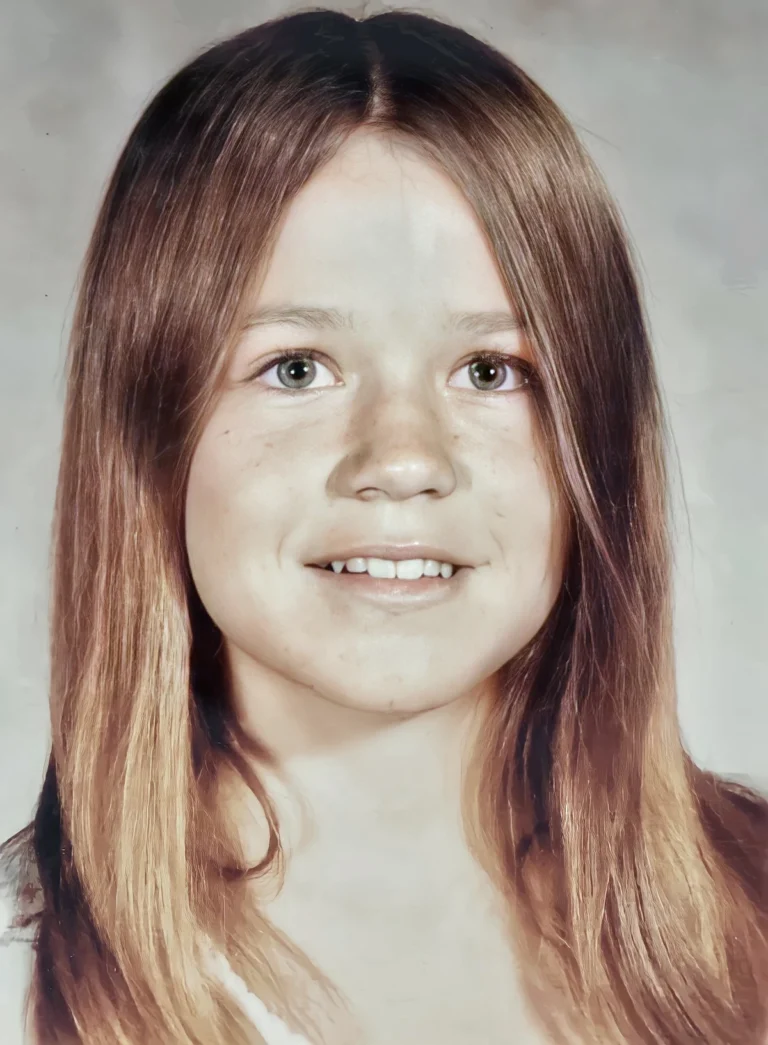
Stephanie Sempell was born on the 8th of November, 1960, in Boca Raton, Florida. She was one of eight children to Dorothy Appel and Richard Sempell and she grew up in a South Florida that was still finding its identity. Boca Raton was a sun-drenched patchwork of retirement communities, tourist sprawl, and a restless younger generation that had absorbed the tail end of the counterculture. By the time Stephanie was a teenager in the mid-1970s, the hippie movement that had swept America in the 1960s was fraying at its edges, but its freedoms and dangers lingered.
For a 15-year-old described by those who knew her as a “chronic runaway,” the road held a particular pull. Stephanie was said to be a “free-spirited girl”, a girl who had a peacock tattoo on the underside of her left arm. In the summer, she helped out at family-owned hardware store in New York. One day in March of 1976, Stephanie told her mother she was heading to the Florida Keys with some friends. She walked out the front door and was never seen alive again.1
The label “chronic runaway” has a bureaucratic coldness to it that can flatten a young life into a category. But it also explains, in part, the institutional failures that would follow Stephanie’s disappearance. The family later claimed that they reported her missing, but for some unknown reason, there is no record of that report. As a result, Stephanie’s name and description was never entered into any database where a comparison could have been possible.
This was not that unusual for the era. In the mid-1970s, there was no national missing persons infrastructure of the kind that exists today. The National Center for Missing and Exploited Children would not be established until 1984. Runaway teenagers, in particular, were frequently treated by police as a social problem rather than a criminal one. They were seen as children who had chosen to leave, and would likely return on their own. A 15-year-old girl who had run away before, who had left voluntarily and told her mother where she was going, did not automatically trigger a search. The system, such as it was, had little mechanism to distinguish a teenager who had simply moved on from one who had come to harm.
The Florida Keys in the spring of 1976 were a natural destination for young drifters. Key West had developed a reputation as a gathering point for what locals called the “freak” population – the transient young people drifting to the island, many of them part of a fading but still visible counterculture. The Overseas Highway, US Route 1, stretched 113 miles from the Florida mainland to Key West, threading through a chain of coral islands. Along that road were rock pits, campgrounds, and informal gathering spots where young people congregated, far enough from authority to feel free.2
Hitchhiking had reached the height of its popularity during this period, seen by many young people as both a practical means of travel and a romanticised act of freedom. For a teenager like Stephanie, getting to the Keys with friends would have been straightforward – thumb out on the highway heading south, and within a few hours, the world of Boca Raton dissolved behind her.
Then on the 30th of December, 1976, nine months after Stephanie was last seen, a camper from Lake Worth was in the area of Grassy Key when he had a strange encounter. He and a friend had recently stayed in the area. They told police they were approached by a “hippie-type” man who offered to show them a human skeleton for a quarter. The camper reported the location to the police.3
Detective Richard Roth was dispatched to investigate reports of human remains found on Grassy Key near an area called the “rock pit” at the 55.5 Mile Marker on US Route 1. The area was a known haunt for campers and party-goers. Detective Roth found the bones scattered in a heavily wooded area. The remains were partially covered by Spanish moss, leafy debris and vines, and were estimated to have been there for months.4
The scene yielded almost nothing in the way of identifying information. The only clothing found at the site was a black T-shirt. It was knotted in such a way that Detective Roth believed it had been tied around the victim’s head, perhaps as a blindfold. Hair was found tangled in the knot. On the T-shirt was a colourful depiction of a Tiffany lamp.
The bones were photographed in place and then collected. The medical examiner at the time, Dr. A. J. Fernandez, found no signs of violent death, and the cause of death was classified as unknown. Given the skeletal state of the remains and the passage of time, this was perhaps an inevitable conclusion – but it was one that Detective Roth never fully accepted. Remembering the knotted T-shirt, he said he always suspected foul play.5
Dental records were used to compare the body against law enforcement reports of missing women from across the country, but failed. With no identification forthcoming, the remains were placed in a cardboard box and stored at the Monroe County Sheriff’s Office in Key West. The unknown girl was estimated to have been between 17 and 19-years-old. The case went cold.
The cardboard box sat in a sheriff’s office in Key West for the better part of two decades. Periodically, the case would surface again when a family came forward believing the unidentified girl might be their own missing loved one. In November 2001, the mother of a girl who had gone missing in 1974 in the Keys became convinced the bones belonged to her daughter. At her insistence, detectives took DNA samples from the mother and tried to match them with DNA extracted from the bones found on Grassy Key. The tests failed.
This attempt at identification, however, prompted detectives to take a forward-looking step. The Grassy Key DNA test was entered into the FBI’s Mitochondrial DNA Missing Person Database, Unit II, in Quantico, Virginia, in the hopes that sometime in the future the database would help identify the victim. It was a small but significant act of institutional faith – an acknowledgment that the tools available in 2001 might not be the tools available in 2010, or 2020, and that the case deserved to remain open to those possibilities.
Meanwhile, the girl in the box remained nameless. Her family, if she had one, did not know where she was.
In 1997, twenty-one years after her sister’s disappearance, Kim Quinn of New York began making phone calls. Quinn, then 50-years-old, had spent decades living with the absence of her younger sister Stephanie. She had no proof of what had happened, only the silence that had settled over the family since 1976, and a gnawing need for answers. She later remarked: “I’ve even gone to psychics to try and see if she was alive or se was dead. Sometime I used to wonder if I would even know her if I bumped into her. Would I recognise her?”
Quinn was already living in New York, raising her own family when her youngest sister disappeared. She remembered: “I just didn’t think she would write off her whole entire family. That just wasn’t in her nature.”[/note] When Quinn began making inquiries, she discovered that because there was no official missing persons report in existence, her missing sister was not in the nationwide missing child database. The family had always believed they had reported Stephanie missing at the time. But whatever had happened – a miscommunication, a bureaucratic failure, a report that was taken informally and never formally logged – there was no record. Stephanie Sempell, who had been missing since 1976, effectively did not exist in any law enforcement system.
As a result of Quinn’s inquiries, Sempell’s data was finally entered into the system. It was a straightforward act that should have happened in 1976, and its delay had cost the investigation more than two decades. Once Stephanie’s name and description were in the database, the existing case files could begin to be checked against it.
Finally, the Florida Department of Law Enforcement asked the National Center for Missing and Exploited Children to look at the case. An “age enhancement” image was made and it appeared to be a match.
“Gerry Nance from the Center for Missing and Exploited Children called Detective James Norman in December 2003 and said he had a possible hit on the Grassy Key case. We already had the DNA from the bones entered in the FBI DNA database. At that point, the mother of Stephanie Sempell was contacted for a sample of her DNA for comparison,” recalled Detective Sergeant Patricia Dally, who headed up the Monroe Sheriff’s Office Homicide Division.
Jim Giumenta, the Cold Case detective for Palm Beach County, and FBI Agent Chuck Wilcox helped obtain the DNA from the mother. Dorothy Appel, Stephanie’s mother, was still alive still waiting, after nearly three decades, for some word of what had happened to her daughter. She provided the sample. The analysis was conducted, and the result came back quickly.
The bones in the cardboard box belonged to Stephanie Sempell. She had been 15 years old when she died, not 17 to 19, as originally estimated. The years between her leaving home in March 1976 and the discovery of her remains in December of the same year remained, and remain, entirely unaccounted for.
The identification was made official in August 2004, when Sheriff Rick Roth made the announcement. “New technologies, better networking between law enforcement databases and a caring family have allowed us to finally identify this body as that of Stephanie Sempell,” he said in a prepared statement. “This investigation is still active, and now that we have an identification, we hope we can go on to find out why Stephanie was found dead on Grassy Key 28 years ago.”
Identification is not the same as resolution. Knowing who Stephanie was did not explain how she died, or at whose hands, or in what circumstances. The cause and manner of her death remain officially undetermined. The case is classified as a suspected and no suspect has ever been named. To date, no one who has been questioned in the case can definitively say who she was travelling with. Detectives would like to talk to those mysterious travelling companions. They are also hoping that friends may remember something significant.
According to one of Stephanie’s sisters, Karen, she had warned her sister about a male friend who she was heading to Key West with. She recalled: “I didn’t feel right about her going. I wouldn’t let im come in the house.” He has never been publicly identified.6 The “hippie-type” man who reportedly offered strangers a tour of her skeletal remains for a quarter was never identified. Whether he was the person responsible for her death, a local eccentric who had stumbled across the body himself, or something else entirely, no one knows.
Detective Sergeant Dally said it plainly: “Somebody knows her and knows what happened to her back in 1976. We want that person, or those people, to call us. A young girl lost her life, and both she and her family deserve to have some type of explanation for that. We’d like to give it to them.”
Stephanie Sempell was interred at Boca Raton Municipal Cemetery and Mausoleum in Palm Beach County, finally given a resting place with a name. The Monroe County Sheriff’s Office Major Crimes Unit continues to accept tips on the case. Anyone with information is asked to call 305-289-2410.
She was 15 years old. She had her whole life ahead of her. Someone out there knows what happened.
Footnotes:
- The Miami Herald, 26 August, 2004 – “Remains of Girl Missing for 28 Years”
- Keys Weekly, 16 October, 2023 – “Keys Historian Traces”
- The Miami Herald, 26 August, 2004 – “Bones of Teen Girl”
- South Florida Sun Sentinel, 26 August, 2004 – “Remains are Linked”
- Boca Raton News, 26 August, 2004 – “DNA Solves Mystery”
- The Palm Beach Post, 9 November, 2004 – “6 Sisters Reunite”




Comments:
This is so fucking sad, I’m sure someone did something. She didn’t die just because she wanted to die, i hope someday they find the culprit